New museum in Bamoun Kingdom chronicles Cameroon's history
By Jean-Christophe Brunet · 2024-05-31
Reported by Jean-Christophe Brunet. Originally published by Global Voices on 31 May 2024. This is an archived report; dates and circumstances refer to its original publication.
On April 13, 2024 , a museum opened in Cameroon that celebrates more than 600 years of history through the treasures of the Bamoun Kingdom , one of the oldest kingdoms still in existence on the African continent.
Established in 1384, the Bamoun Kingdom today represents a significant part of Cameroon's history. Geographically, the Bamoun cultural community spans an area of 7,700 square kilometers (27,973 miles) and has nearly two million inhabitants . The inauguration of this gem enhances the visibility of this kingdom, which is little known outside the region.
Cameroon is a bilingual country where French and English are spoken by 70 percent and 30 percent respectively of a population estimated at over 29 million . The country is home to 270 ethnic groups, each with its own national language, divided into major families: the semi-Bantu , the Bantu , the Semites , the Hamites , and the Sudanese. The Bamoun people belong to the semi-Bantu group, alongside the Kaka , Baya , Widekum , Tikar , Bamiléké , and others.
The museum
Built on 5,000 square metres (1.2 acres) in the city of Foumban (the capital of the kingdom in the Western region of Cameroon), the project is the result of an initiative launched in 2013 by the late Ibrahim Mbombo Njoya (1937–2021), the 19th reigning king, and father of Mouhammad-Nabil Mforifoum Mbombo Njoya , the current king of Bamoun since 2021.
The museum's striking architecture features significant symbols: a two-headed serpent representing strength and power, a giant spider symbolizing work and wisdom, and a double bell to signify patriotism and unity. During the inauguration on April 13, 2024, Mouhammad-Nabil Mforifoum Mbombo Njoya speaking to the Voice of America (VOA) declared that:
The museum was a means for us to take pride in our past, to build the future, and to show that in Africa, we don't import thoughts.
The museum houses objects of artisanal and artistic significance: presses, Bamoun drawings, mills; along with sacred items linked to royal authority: weapons, masks, musical instruments, pipes, and statuettes. There are also manuscripts and a corn-grinding machine invented by King Ibrahim Njoya (1889–1933).
Speaking about Ibrahim Njoya ‘s legacy, the current king told Voice of America :
We pay tribute to a king who was both a guardian and a pioneer (…), a way for us to take pride in our past to build the future and to show that in Africa, we don't import thoughts.
This video posted on Carrefour Television ‘s YouTube channel outlines the history of the Bamoun Kingdom Museum:
A proud feeling
The creation of this historical space is a sign that the traditional wealth that abounds in the kingdom is being recognised nationally.
Alexis Mouliom, cultural affairs attaché at the Bamoun Palace and secretary-general of the Nguon Foundation, believes that the kingdom's history is finally accessible to everyone. He stated to Radio France Internationale (RFI):
Historically, at the end of each reign, (…) all the major symbolic items of the king were collected and stored in this house of the Ndagu country, which is the predecessor of the Bamoun Museum. Thus, over 600 years of the Bamoun Kingdom's history, an enormous collection has been accumulated through the reigns, constituting nearly 12,500 objects.
For his part, Armand Kpoumié Nchare, who has a Ph.D. in geography and specialises in cultural heritage, cited in an article by Voice of America , emphasises:
For Cameroon, such a museum dedicated to the history of a kingdom is unique in its scope, as is the enthusiasm surrounding its inauguration. It is one of the few kingdoms that has managed to exist and remain authentic despite the presence of missionaries, traders, and colonial administrators.
François Bingono Bingono, anthropologist and university professor, also visited the Bamoun Kingdom Museum. In an interview with Africanews , he stated his belief that the objects displayed in the new museum go beyond Bamoun tradition and culture. For him, it is the entire Cameroonian heritage that is represented:
There is not only Bamoun culture. I recognized the forest culture, meaning the southern forest, the regions of the east, center, and south. I recognized the cultural heritage of Loum, the cultural heritage of the High Plateaus, and the cultural heritage of the north. So, this is at least an ideal place where one can come to find resources related to Cameroonian cultural heritage.
With the inauguration of this museum, the Bamoun people thus leave their mark on Cameroon's history and present a renewed image of cultural heritage. This event complements the Nguon Festival (a cultural event of the Bamoun Kingdom), which, since December 2023, has been inscribed as an intangible cultural heritage of humanity by the United Nations Educational, Scientific and Cultural Organization (UNESCO). The next edition of the Nguon Festival will take place from November 29 to December 8, 2024 , in the city of Foumban.
Many works of art from African countries are still held in colonial museums that are still reluctant to permanently return these cultural assets. While some countries like Benin and Nigeria have managed to partially reclaim their heritage , Cameroon has not yet been as successful. However, in January 2024, the country received a decision from German authorities to return the sacred statue of the Nso people . This achievement was largely spearheaded by Njobati Sylvie , a pan-African activist for art and culture. The statue, stolen 120 years ago, had been on display in a Berlin museum .
Since 2022, Cameroon has established an interministerial committee tasked with overseeing the repatriation of illegally exported Cameroonian artworks and cultural assets.
Image credit
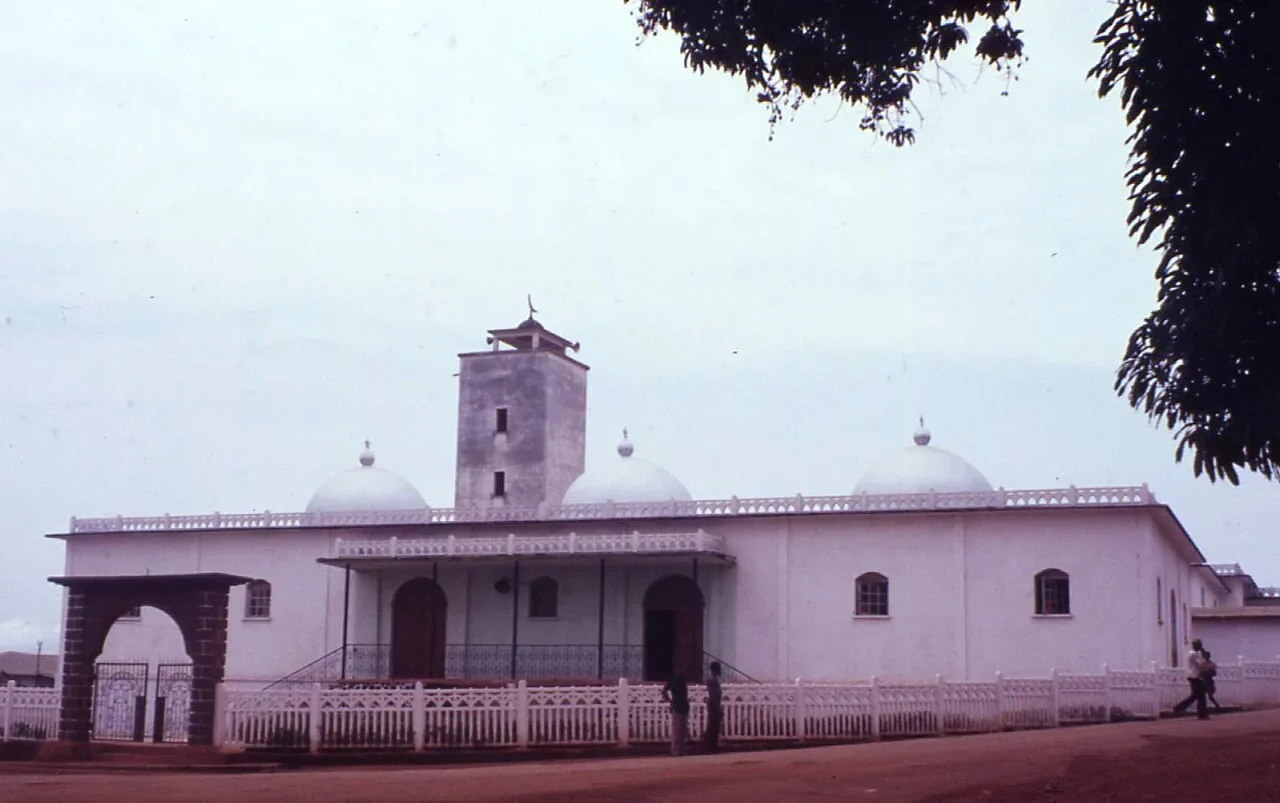
Cover context image: Mosquée à Foumban en mars 1973. This archival or illustrative image is not presented as a photograph of the reported event. Creator: Jean-Louis Heckly. Original image and full attribution. License: CC BY-SA 4.0. Resized and compressed for web display; the image retains its stated license.
Publication credits
Written (Français) by Jean Sovon Translated (English) by Jean-Christophe Brunet. Original report published by Global Voices. Republished under Creative Commons Attribution 3.0. Adapted for Gistmax: formatting simplified; duplicate original-language quotations and embedded media omitted; cover photograph replaced. This republication does not imply endorsement of Gistmax by the author or publisher.